Wednesday, January 16, 2019

Our digs

Many friends have asked what our living arrangement is like, so I thought I'd fill you in on that. As I mentioned previously, we live at the W. F. Albright Institute of Archaeology, an historic 1920s  Late Ottoman building. Located  on Salah Ad-Din Street, a major artery in East Jerusalem, it's only a few minute walk from the Damascus Gate into the Old City.


The elegant entrance to the Director's apartment is on the other side of the building from us. The public spaces include offices, a library of some 35,000 volumes, lab spaces, lecture/reception hall, gathering space, and a dining room.


Yesterday, I was part of a women's Pilates class for residents which met in the space below. Last week, the same space was used with chairs set up for a lecture.


After the lecture, this adjoining space was the site of a reception for attendees to meet and greet each other and the lecturer.


This living room is used for smaller receptions and adjoins the dining hall and kitchen.


One of the most charming features of the building is the outdoor courtyard. It's not warm enough to use yet, but I know we will spend more time there as the weather warms up.


Our apartment is on the second floor in the wing opposite the director's apartment. The floors are stone tile and the ceilings high. We enter via stairs.


The dining room/entry is the first room, from which all the other rooms branch -- a living room, kitchen, bathroom, and two bedrooms.


Just opposite our door, we have a balcony that overlooks the courtyard. We've had tea outside on a sunny day once so far, but I envision us eating outside and enjoying the space more as the weather warms up.


The neighborhood around us is full of all sorts of shops -- books, clothes of all kinds, housewares, spices, fresh baked breads, fresh fruits/veggies, coffee shops, falafel and shwarma stands, and restaurants.


A five-minute walk away is a pleasant park with picnic tables, a very extensive playground, and outdoor exercise machines. Just this morning, we went down and used them for an upper body workout.


A favorite spot we've discovered for a break in the day is the Nordic Cafe, which has a simple sandwich/soup menu with some good veggie options, tea/coffee, and dessert veggies (a.k.a. carrot cake). Sten hopes to supply them with a Norwegian flag in the future as they only display the Swedish and Icelandic flags. The space is cozy and relaxed.


My favorite drink option is their ginger mint tea, made with fresh ginger root and fresh mint leaves. Can it get healthier than that?


So now that you know our environs, I wish you Peace. Salam. Shalom. 
P.S. Apparently, the weather forecast is for some snow tonight. It happens every few years.

Monday, January 14, 2019

St. Anne's Church and the Pool of Bethesda

As a musician and singer, I love to visit is St. Anne's Church in the Old City. According to tradition, the church honors the site of the birthplace of Mary, Jesus' mother, and is erected in honor of St. Anne, Mary's mother. Located next to the busy street coming in the Lion's Gate in the Muslim Quarter, it has a beautiful garden at its side.  As you can see, the church is rather simple and unadorned from the exterior.


However, the church's acoustics make it extraordinary. They make any singer sound fabulous. Reverberations continue for seconds after one sings, and fill the place completely. I remember visiting St. Anne's with my husband and three sons many years back when our children were all pre-teen. We took a photo in the courtyard outside the church which I wish I had access to here. I had told the boys about how wonderful it was to sing in the space, and that we'd sing when we went there. As we sat down in the empty pews, I heard a sweet boy soprano. One of my sons (probably 6 years old at the time) began singing "Sing Hallelujah to the Lord" which the rest of our family joined in as a two-part round. The sound was magnified over and over and returned sounding magnificent. Such a special memory! This past week, because the church was almost empty, Sten and I braved singing Dona Nobis Pacem in the church. A young monk in his white robe joined us. He told us afterward that he is from Burkino Faso and located in Jerusalem now.


Statue of St. Anne and Mary on the left back of the sanctuary.


Under the church is this small chapel.


St. Anne's church is right next to the traditional sight of the Pool of Bethesda, The story of Jesus healing a man who had been waiting by the pool because no one could help him get into the healing waters can be found in John 5 in the New Testament of the Bible. Apparently, the waters were occasionally stirred by an angel and the first into the water after this happened would be healed. Jesus told the man, "Rise, take up your bed and walk" and the man was healed.


What amazes me at this site is how deep in the ground the street level was at that time. I'm at the current street level when taking the photos below.


Just around the corner from the St.Anne's Church and Pool of Bethesda complex is the traditional site of Mary's birth. At the street level is a commemorative shrine.


Then you climb single-file down some narrow winding stone stairs to a room where Mary, according to tradition, was born.


As we stepped out into the street again we heard the call to prayer from the nearby mosque. The sky was clear and a beautiful crescent moon was shining. 


Peace. Salam. Shalom


Friday, January 11, 2019

Week One in Jerusalem

Note: This blog originally was created to document travels and experiences while living in Norway during 2014-2015. I'm restarting it now to document our time living in Jerusalem this year. The text and photos here are a record of my personal experiences and reflections, first for my husband and me, but also for family, friends, and others to share our journey. I hope you enjoy your visit here. I welcome your comments.

New Years Day 2019, Sten and I arrived at Ben Gurion airport in Tel Aviv. A shared taxi took us and  a dozen other varied travelers the hour's drive to Jerusalem and directly to our destinations. For us, that was the G.F. Albright Institute of Archaeology in East Jerusalem, where my husband has an annual professor fellowship. This will be our home for the next 4 1/2 months. The institute houses offices, a library, a lecture hall/gathering space, several apartments, a hostel, a dining hall and kitchen. It's built on three sides of a beautiful stone-paved court yard.


Getting settled into our apartment, meeting the staff and other scholars here this term, finding the closest and best grocery shopping, getting acquainted with our neighborhood, and overcoming jet lag have been my current goals. However, we have also managed to experience some other special things in this first week.

In exploring our neighborhood, we became aware that The Edward Said National Conservatory of Music, affiliated with Birzeit University, is just around the corner from us. Last week they  celebrated their 25th anniversary with a concert featuring performances by many of their ensembles. These ranged from a brass group and a string orchestra playing classical works by European composers to various ensembles featuring vocalists, oud (precursor to the lute), qanun (a flat, zither-like instrument of 26 strings played by plucking), flute, drums, and cello. The quality of musicianship was excellent and the concert was very enjoyable.


Friday evening at the beginning of Shabbat we walked into the Old City to the Western Wall. We've been there many times, but I've never seen it so crowded with people, celebrating the beginning of the   Sabbath. Men and woman, as in a synagogue service, worship and pray in different places, so Sten and I separated as well. Within minutes of entering the women's section, I was pulled into a circle dance of women, linking elbows and stepping in unison one direction, then the other,  moving in towards the middle of the circle, then out, and with lots of jumping in the process.  The music was created by the women themselves, either singing words (which of course I didn't know) or just singing the syllable "na" (which I quickly was able to join in on). There was an exuberance and joy in the atmosphere that was very contagious. Excellent exercise, I must say.


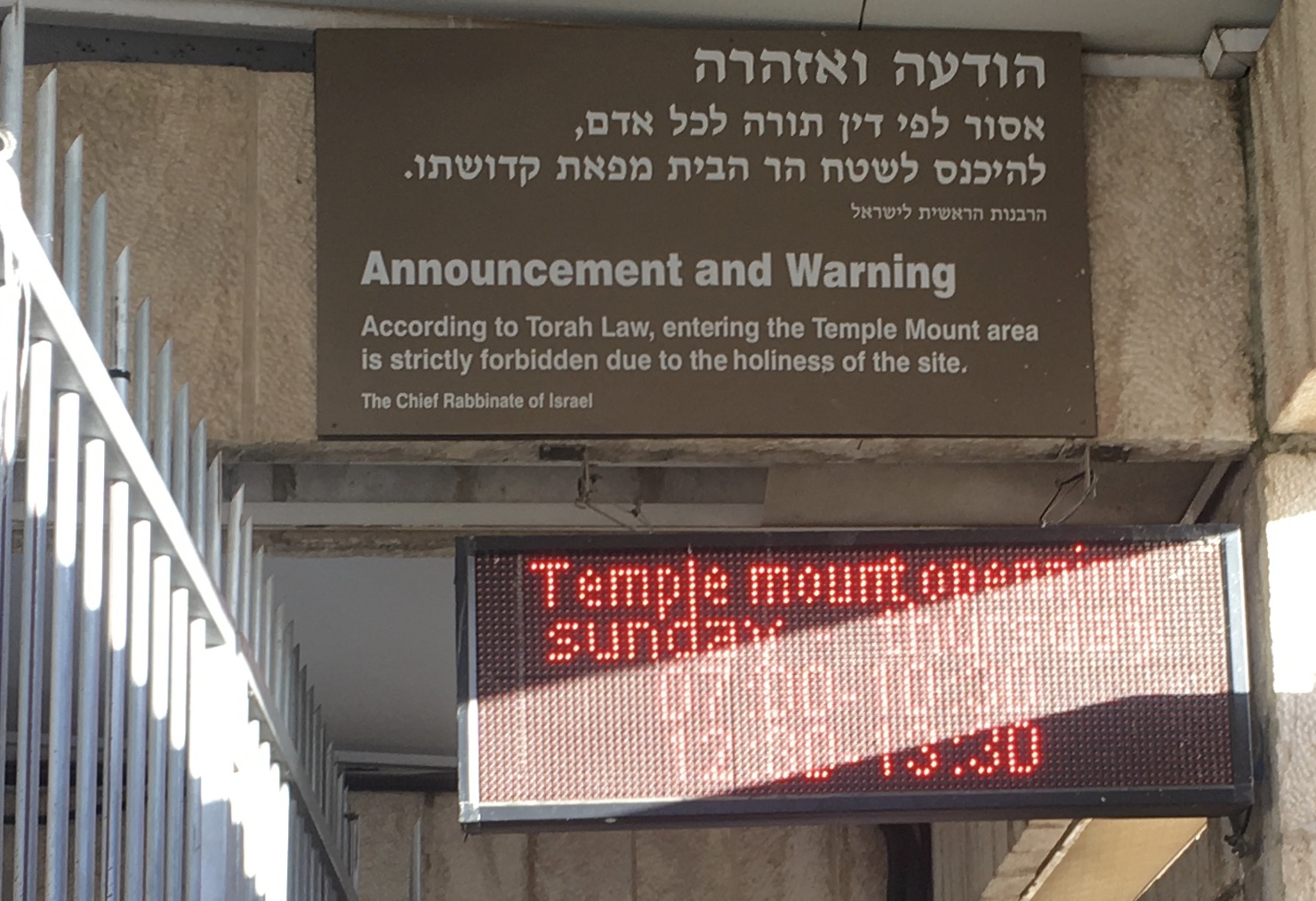
One morning at 7:00 a.m. we joined others from the Albright for a tour of the Temple Mount area, led by an art historian who has worked on restoration of the ceramic tiles on the Dome of the Rock. This area is only open to non-Muslim visitors for three hours in the morning and one hour at noon. Years ago, I was able to enter both Al Aqsa mosque and the Dome of the Rock shrine, but now they are only open to Muslims. In order to not wait long, we were in line at opening time. One must bring along a passport and go through airport-like security checks to enter. In the photo above, you can see the elevated wooden walkway (center of picture) which is how you enter the area.


The Temple Mount is much larger than one might expect. And because of its elevation, the winds can  feel rather strong on a cold morning. It's certainly an impressive area of the Old City worth visiting.


Because of the connections of our guide, we were able to see the small workshop of the craftsmen who build the replacement windows for the Al Aqsa mosque. Not only was their work interesting, but the shop was warm -- a very welcome respite from the sunny, beautiful, but cold day outside.


The most impressive part of the Temple Mount is, of course, the Dome of the Rock. Next to Mecca and Medina, this place is the 3rd holiest site in Islam. It is built over the stone from which the Prophet Mohammed is said to have ascended into heaven. The late King Hussein of Jordan was responsible for the restoration done in 1998, apparently funding the cost of the 80 kg of gold used to coat the dome by selling one of his homes in London. The shining golden dome is visible from all around the city, and the shrine's mosaics and tiles are stunning.


 All in all, I think we've had an  event-filled first week in The Holy City,  Peace, Salam, Shalom.